Miah Smith
Waikato, New Zealand
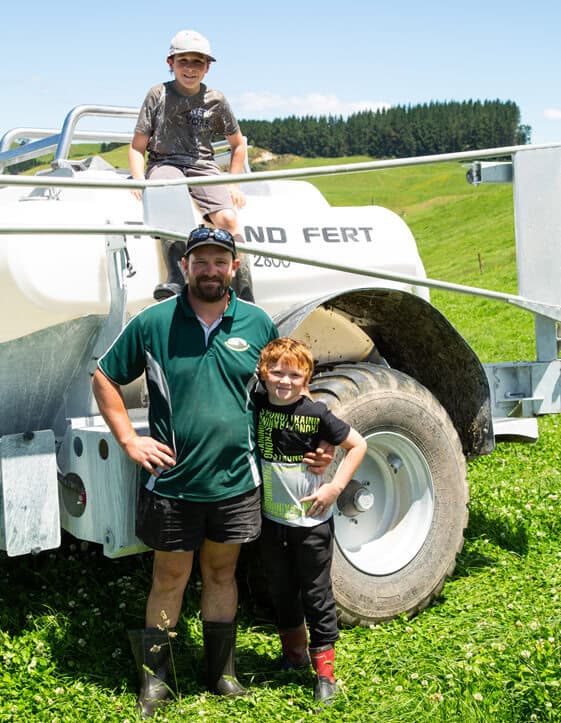
Caption: Miah and his sons
This story was filmed in 2019 and reflects one farmer’s own experience with their Tow and Fert. Every farm is different, so please treat it as a story rather than a forecast for your place.
Miah Smith runs a biological fertiliser programme through one machine on hill country near Atiamuri that used to only suit sheep and beef.
Atiamuri, in the central North Island just south of Rotorua, is hill country that’s traditionally run sheep and beef, or gone into forestry. Miah Smith and his family run a dairy operation on it instead, milking around 530 cows across 350 hectares, 260 of them effective.
When Miah and his wife Jenny first took the place on, it was a converted forestry block, barren and dry, short on life in the soil, with weeds and gorse running rife. Over the last seven years they’ve rebuilt it into a working dairy farm, and the fertiliser programme has kept changing as they’ve gone.
For most of those seven years the approach was conventional: standard super or DAP, and nitrogen at a rate Miah describes plainly.
We’ve been pretty conventional for the past seven years here, using sort of 150 kilos of N a hectare.
Miah Smith, filmed 2019
That started changing with a three year trial of AgriSea seaweed products, and what Miah saw in the ground underneath the pasture. Filmed partway through the switch in 2019, he put it this way:
We’ve done a three year trial of AgriSea, and we’ve got really good root depth and getting our pastures to stay there for longer than 2 or 3 years. We’re moving to regenerate the farm using biological fertilizers, and drop our N back to sort of 50 or 60 units. So half. Which we’ll manage to do this year.
Miah Smith, filmed 2019
Miah had been watching the Tow and Fert for a few years before he bought one. The hold-up wasn’t the idea, it was the machine: the models on offer were either too small for the farm or too big for the hills. He waited for the gap to close.
Thinking about Tow and Fert?
Talk with a specialist
Tell us about your operation and we’ll match the right model and setup for you.
I had to wait until they made this new model and we can go sort of 90% over this farm now with this model.
Miah Smith
That model was the Tow and Fert Multi 2800, and Miah bought the very first one Metalform built, at National Fieldays at Mystery Creek in 2018. It’s built to handle the hills the smaller models couldn’t cover and the larger ones couldn’t manage on the slopes.
The machine dissolves nitrogen straight in the tank and carries small seeds, clover, plantain, chicory, through in the same pass, so Miah can put fertiliser, seaweed and seed on in one run instead of several. He rates it mainly as a time saver: one pass, one tank, nothing else to organise afterwards.
Miah changed several things at once alongside bringing in the machine, dropping super and DAP altogether and moving to biological fertilisers in their place. What he told us about cost is his own account of that whole system, not a result we’re putting down to the machine on its own.
Cost wise we’re saving quite a lot of money. We’ve cut our fertilizer bill for the nitrogen in half in the first year. So over the whole farm it’s a fair savings. We’ve got away from using supers and DAP so we’re not putting any of that on. Instead we’re using biological fertilizers to release that to the plant. So that’s seaweed, using a bit of fulvic acid. We’re using quite a bit of fine lime, magnesium, elemental sulfur. And then your trace minerals which are all on with your seaweed. So the Tow and Fert will be paid for, I think, in one and a half years.
Miah Smith
Asked what he’d tell another farmer weighing it up, Miah kept it simple.
If there was a farmer out there that wanted to cut his N use, grow the same amount of grass and save a bit of money, then this would be the way to go.
Miah Smith
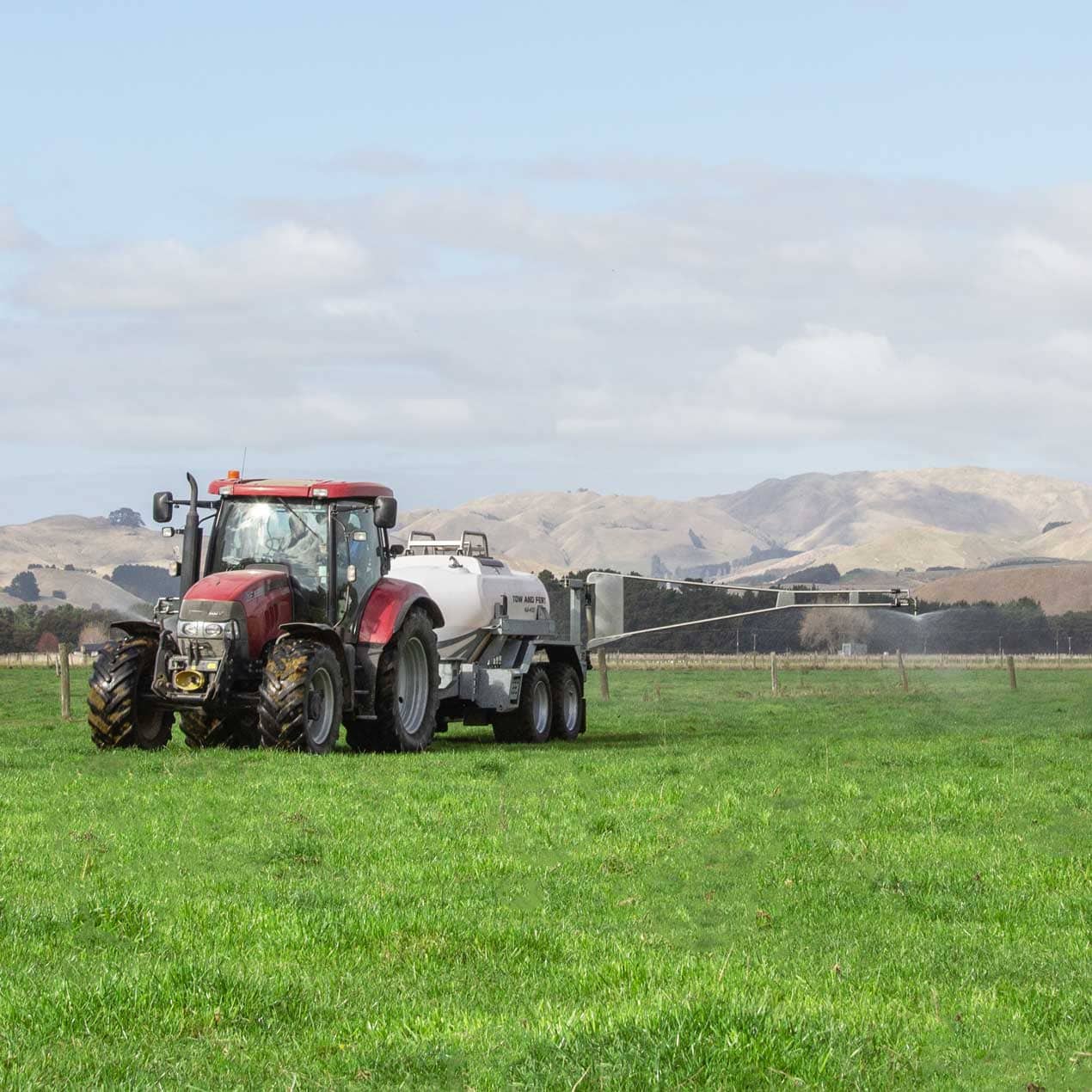
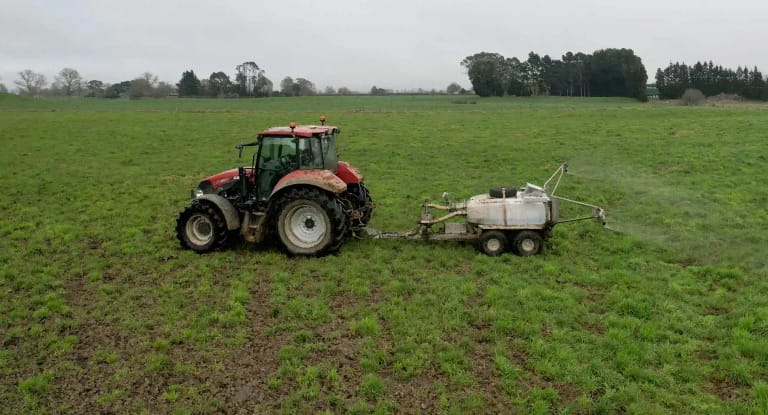
Miahs tractor